Tuesday, May 13, 2014

Presentation at WASWAC Seminar at BSWM, DA

Yesterday, some officers of the World Association for Soil and Water Conservation (WASWAC) and soil scientists and engineers from Thailand, led by Dr. Samran Sombatpanit, Past President, and Dr. Li Rui (China(, Current President, of WASWAC, participated in a seminar organized by the Bureau of Soils and Water Management (BSWM), DA, in Quezon City. The group of Thai and Chinese scientists came from Aklan and attended the annual meeting of the Philippine soil scientists.


Weeks before that, I was asked by Doc Samran, a good friend for nearly a decade now, if I can present our experience at terraces construction in the said seminar, which I quickly agreed.


There were four paper presenters supposedly yesterday, but the Filipina speaker who was supposed to present a paper on vetiver grass for erosion control did not come. So only me, Dr. Alibuyog, an agricultural engineer from Mariano Marcos University in Ilocos Norte, and a Thai scientist, made presentations.


BSWM Director, Dr. Silvino Q. Tejada, along with almost all division chiefs and directors of the Bureau, were there.


Monday, May 05, 2014

Conserving Organic Materials

Every year, mahogany trees change all of their leaves around February-March, and grow a new batch of leaves. by March-April  Other tree species also exhibit this annual process, at different period or months. So the volume of fallen leaves, dried branches, especially if the trees are already big, is huge, like below. All photos below as of yesterday, when I visited the farm over the weekend.


After collecting the dried leaves and other organic materials. Oh, the langka/jackfruit, I forgot to bring it home to Manila. It's one of the minor products of the farm. Ok, so where did we put this huge volume of organic materials?


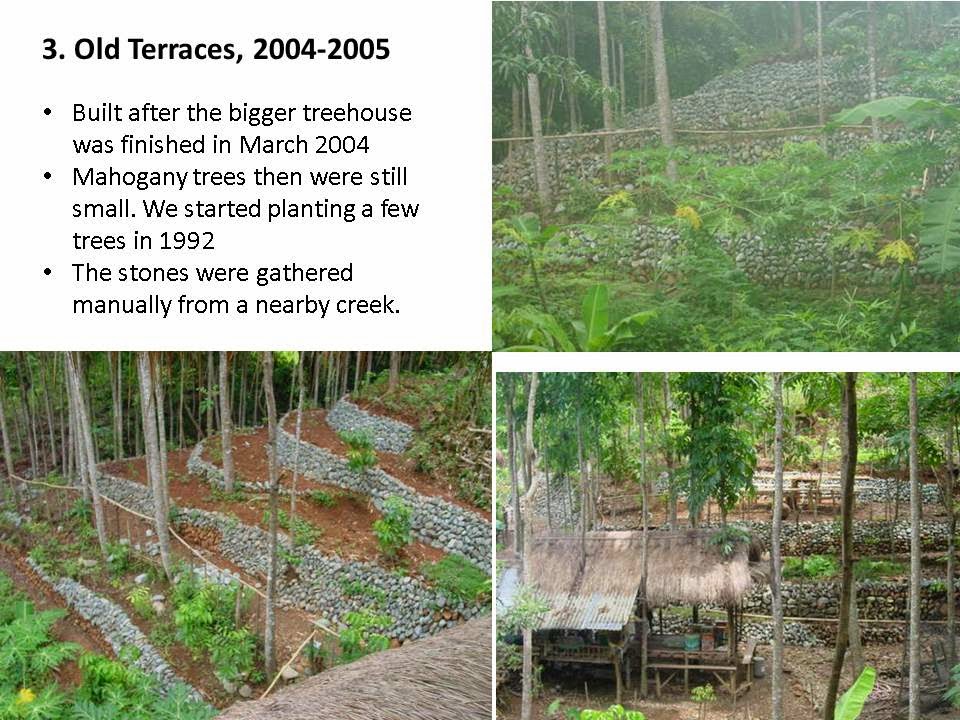
Here, impounded by stones gathered from a nearby creek. The newly collected materials just topped off the old layers of dried organic materials.


If you remove the top layer of the dried leaves, below it are decomposed materials that became rich top soil. Trees develop new small but elaborate roots on its lower trunk, above the original soil level, to get rich minerals from their new topsoil.


Other views or angles of the collected materials.


We are just lucky to be near a creek where many big stones can be gathered, manually.


Nong Endring Paragas, our farm caretaker for many years. He is holding a stick approximately 1 meter long. This side is 5 meters long. The average height of the collected materials is about 0.5 meter high. And the width, around 2.5 meters.

So estimated volume of organic materials collected in this part of the farm is:

Volume = Length x Width x Height = 5 x 2.5 x 0.5 meters = 6.25 cubic meters,
advanced staged of decomposed materials. If these leaves were collected earlier, the volume should be double or more.


Two young boys that I hired to help collect the organic materials, Romeo and Nonong, locals or barrio folks.

These and other photos I will present in a special meeting of officers of the World Association for Soil and Water Conservation (WASWAC) this coming May 12, at the Bureau of Soil and Water Management (BSWM), Department of Agriculture, Quezon City. Dr. Samran Sombatpanit, Past President of WASWAC, also a long time friend, invited me to be one of the presenters that day. Audience will be Chinese and Thai soil scientists and engineers, plus some staff and officials of the BSWM.
------------

See also:
Stone terraces, Part 4, April 10, 2011
Stone terraces, Part 5, May 02, 2013
Stone Terraces, Part 6, February 23, 2014
Stone Terraces, Part 7, March 30, 2014

Maya Bird as Rice Pest

Maya bird or Eurasian tree sparrow is the most common bird to see in the Philippines, both in urban and rural areas. It is also common in many other East Asian countries. A few decades ago, it was the "national bird" in the country, until it was replaced by the Philippine eagle, or the monkey-eating eagle, possibly the biggest eagle specie worldwide.

Maya is considered a pest by many rice farmers. They eat the young and immature rice, or suck fuids in them. Here's a rice straw felled by birds. Notice the lower portion of the straw on the right, near empty, some rice fall on the ground.


The birds are small but they come on a big group, at least 10 or 20, and more. So when they land on these young rice straws, the latter can lean, if not fall to the ground, like they were blown by a strong wind.


The rice field in front of our treehouse in the farm. Photos taken yesterday, except the first photo, taken from the web.


Compared to rats though, maya are second or third serious pests; the other serious pests are the kuhol which mature as helix pomatia, grasshoppers, or even wild ducks. It depends on the season. The rats attack day and night and they can hardly be seen, while the maya attack only at day time, and one can see them. But they just hop and hide from the trees, and swoop on the ricefields.

The most common solution to maya attack is having a wooden statue with dress that looks like a person in the middle of the rice field, or a long string/small rope with cans or other noisy things tied in the middle. When the rope or string is pulled, it creates noise and scares the maya.
-------------

See also:
Vegetable Plots in the Farm, April 17, 2011 
Rice Farms, July 11, 2012 
Rice Terraces, Cool Crops, from Agrarian World, August 02, 2013
Water Impounding and Irrigation, December 05, 2013

Friday, April 25, 2014

Sweden Seminar 2: Highly Mechanized Agriculture

Among the things that awed me in Swedish agriculture (or European agri in general), was the use of huge machineries. They have wide lands but small population and wages are very high. It is more economical to use lots of machines than people in the various phases of farm preparation, crops planting, monitoring, harvesting and hauling.

Like this huge truck, I think it is a harvester and drier at the same time. We visited a farm with about 2,200 hectares of land planted to various crops, mostly wheat and potato, and they have only about 18 workers. Even the farm owner drives one of the tractors or other heavy machineries.


Tne farmers there hardly touch the soil, the machines and tractors are reliable workers for them.


A huge tractor pulling a seed planter. Computers equally distribute the seeds dropped or planted by this red container at the back. With Trung Nguyen from Vietnam and Peter Kiyonga from Uganda.


There are also "moonlight farmers" or part-time farmers. These are people who have regular office work at day time, and they do farming when they come home, say from 6-10pm during summer. A part time farmer can be tilling around 30 hectares on average.This tractor is owned by one part time farmer.


Another tractor from another part time farmer. Usually each part time farmer has one house, one big warehouse where the harvests, some small tractors, are housed. Here with Tony Cudjoe from Ghana.


Will be posting more photos later...

Sweden Seminar 1: Field Lectures, 2003

In September to October 2003, I attended a 7-weeks seminar, "Sustainable Agriculture in an Environmental Perspective" held in Lund, Sweden. We were about 23 participants from 17 or 18 countries, mainly from Asia and Africa. The seminar was funded by Sweden International Development Agency (SIDA) and implemented by Svalof Weibull AB (SW), a biotech research and consulting company. We stayed in a hotel in Lund, then a bus would pick us up every morning and bring us to SW complex for the lectures and some field visits.

I just scanned some hard copies of our photos there. I will upload them in this blog by batches. In this batch, some of our field visits in agri farms in southern Sweden. Btway, never mind the date in the photos, it says 1987. These photos were taken sometime in September or October 2003.


Kidding with one of two North Koreans in our batch. The Koreans, they were small and thin, but I think they were sharp mentally. They were Party members of course.


These huge rolls of dried wheat straw are mixed with some chemicals and are given as cattle feeds during winter, where the grasses are covered by ice, cattle can't eat grass, and it's too cold outside. These wheat straw become their main food inside the barn.


The cattles there, they grow very fast, something like they are gaining weight of around 1.5 kilo a day.


Our program facilitators were Inger Ahman (standing, right most) and Marie Hardfors (
sitting, left most and not facing the camera).


Thursday, April 24, 2014

Treehouse, Versions 2002 vs. 2014

This is the original treehouse in the farm, just a small elevated veranda perched on a lone mahogany tree. Photo taken September 2002. The mahogany trees near the treehouse were small then.


On January 2004, I decided to dismantle it, as my architect friend from UP, Clifford Espinosa, has a good design for a bigger, two-storey treehouse to be perched on the same big mahogany tree. Cliff gave that favor for free, jamming at tagay lang kapalit. Super thanks, once again, Cliff.

The house was finished around March 2004. Last March 2014 or exactly 10 years after, the house got a facelift, the decaying bamboo floor were all replaced. A few changes in the 2nd floor was introduced. The treehouse as of March 2014, below. The surrounding mahogany trees are much bigger. The really big ones have been harvested last January this year.


The small treehouse then was supported by four braces only to stabilize it. The roof was nipa.

It has no toilet then, guests (females especially) must go down (notice the small wooden stairs). Male guests can pee on the rice plants below, if they were not in the mood to go up and down the treehouse. :-) 

On the left and right sides of the treehouse then was sloping. When the new treehouse was built in 2004, the sloping sides have been terraced.

The current treehouse is heavy, there are many posts supporting it, aside from the main tree where it is perched and locked.


The old treehouse from a distance.
-----------

See also:
My Treehouse, May 2012, July 17, 2012
Around My Treehouse, May 02, 2013

My Treehouse, August 2013, August 21, 2014

My Treehouse, March 2014, March 30, 2014

Friday, April 18, 2014

On Grass Fire

Last March 27, 2014 or three weeks ago, there was a big grassfire that started from either the public forest land or our neighboring farm, Mt. Zion, and spread to our farm including the mango area. First two photos I took last March 28.


This photo I took yesterday. On the left was part of the burned area, the right side was spared. One of the guys that make charcoal in the farm, Anoling, was there to help put out the fire that day.


Grass fires occur almost yearly in many parts of the country. Forest land that were converted into agricultural or pasture land, the grass mature during the hot and dry months of March to May, can easily get burned. And grow again days after a fire. This photo is from the web.


Grass fire is the number one or number two tree killer. The other major tree killer is people. Trees generally grow on their own, aka natural regeneration of trees, until some vines choke them, or people cut them, or a grassfire would engulf them. But many local tree species would survive a grassfire, and would have new leaves weeks after a fire.
---------

See also:
From Forestland to Grassland, September 21, 2012  
Natural Regeneration of Trees, February 21, 2013 
Trees in the Farm, Part 4, August 21, 2013

DENR Nursery in the Farm

The Department of Environment and Natural Resources (DENR) through the Laguit Padilla Multi Purpose Cooperative (MPC) has established a nursery partly in the farm, partly in the public forest land area. They informed our caretaker, Nong Endring Paragas about this, no problem. Photos below I took yesterday.


They used different tree species -- kakawate, ipil ipil, gmelina, etc.


The DENR has been planting and planting trees in this part of Bugallon, almost every year, for about four decades now since the 70s. Mostly in the public forest land, below, and partly intruding into private lands.


The DENR and its contracted parties in the past have no sincerity in having a real forest in many parts of the country. Generally the trees just regenerate and grow on their own without human intervention. They only need to be protected from different tree killers -- vines, grass fires (occurring almost yearly) and people who steal and cut the trees for charcoal, firewood, lumber and other uses. Below, another part of the "public forest land".


But the DENRand its contracted parties chose reforestation almost yearly. The latter mainly do it for money. They get paid for planting and do little or no monitoring months after. The newly planted seedlings often die. Until another round of contracted tree planting the next year.
------------

See also:
From Forestland to Grassland, September 21, 2012 
Attempted Illegal Logging by Greedy RE Agents, February 11, 2013 

New Upland Dwellers and the DENR, August 21, 2013

Trees in the Farm, part 2, September 06, 2012
Trees in the Farm, Part 3, February 11, 2013

Natural Regeneration of Trees, February 21, 2013
Trees in the Farm, Part 4, August 21, 2013