Thursday, March 24, 2016

Numbering the trees

We started numbering the various forest tree species in the farm, at least those that are about 5 inches or wider in diameter at breast height (dbh). Danny is in charge of this work. First he used white paint, but it was not visible enough, so he bought blue paint, now more visible.


Those that are at least 8 inches dbh and are harvestable are numbered 01 to 80+, as of last Saturday, March 19 when I visited the farm. Those that are 5-8 inches dbh are numbered 101 to 580+ as of last Saturday.


There are tens of thousands of trees in the farm, mostly mahogany in the lowland, followed by gmelina in the upland, then some eucalyptus, acacia auri and acacia mangium, narra. There are many local and endemic species like molave, karael, etc.


These are planted mahogany trees about 7-8 years ago perhaps. They are standing on rocky soil so they cannot grow fast and big but they are able to survive and thrive.


No big and mature tree that produce seeds yet, so there are no naturally growing trees yet and hence, the spacing is maintained. Once a big tree will produce seeds and scatter them, this area will look "chaotic" with thousands of new saplings growing every year in between those bigger trees.


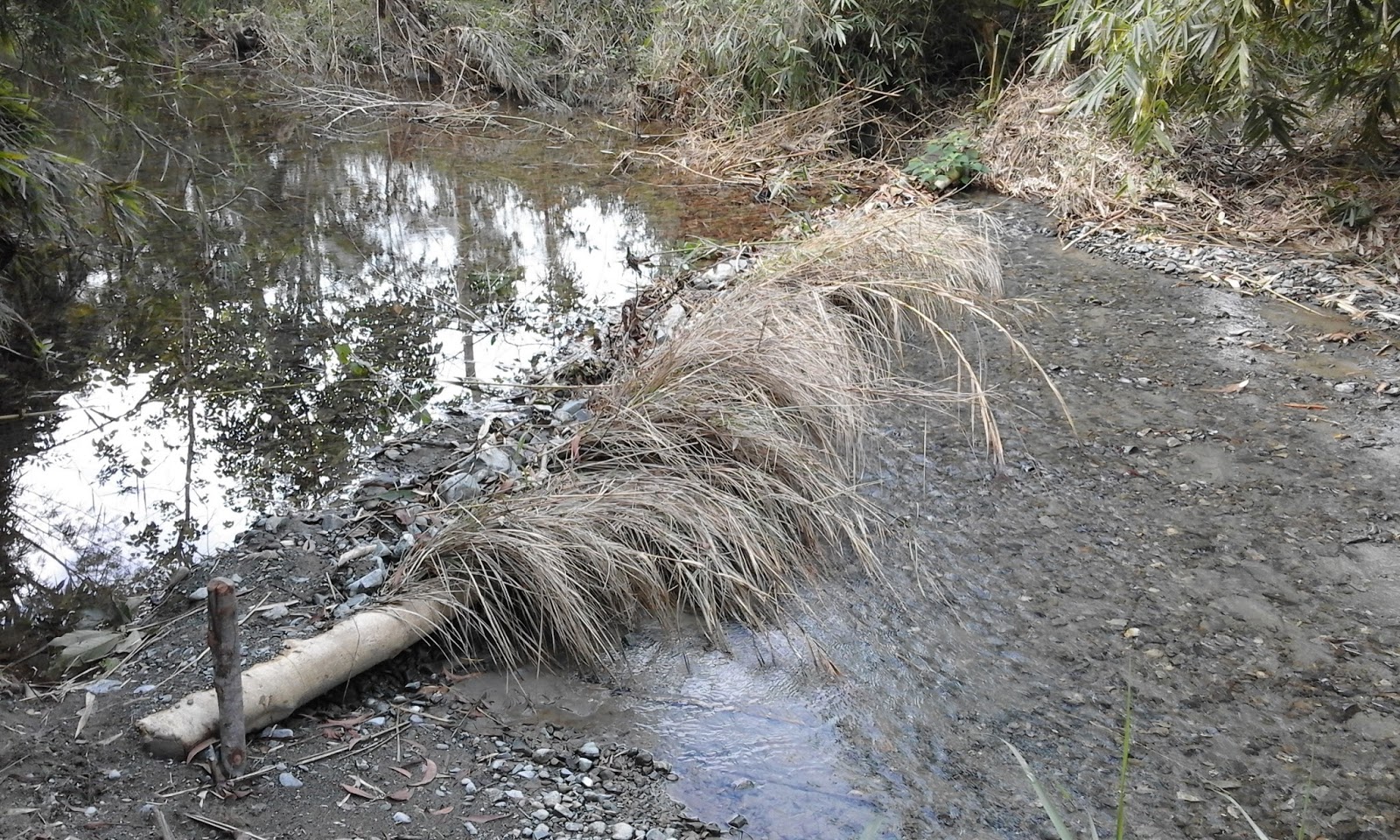
The old canal that diverted part of the water in the creek into the other side, via a small dam and 3 hoses.


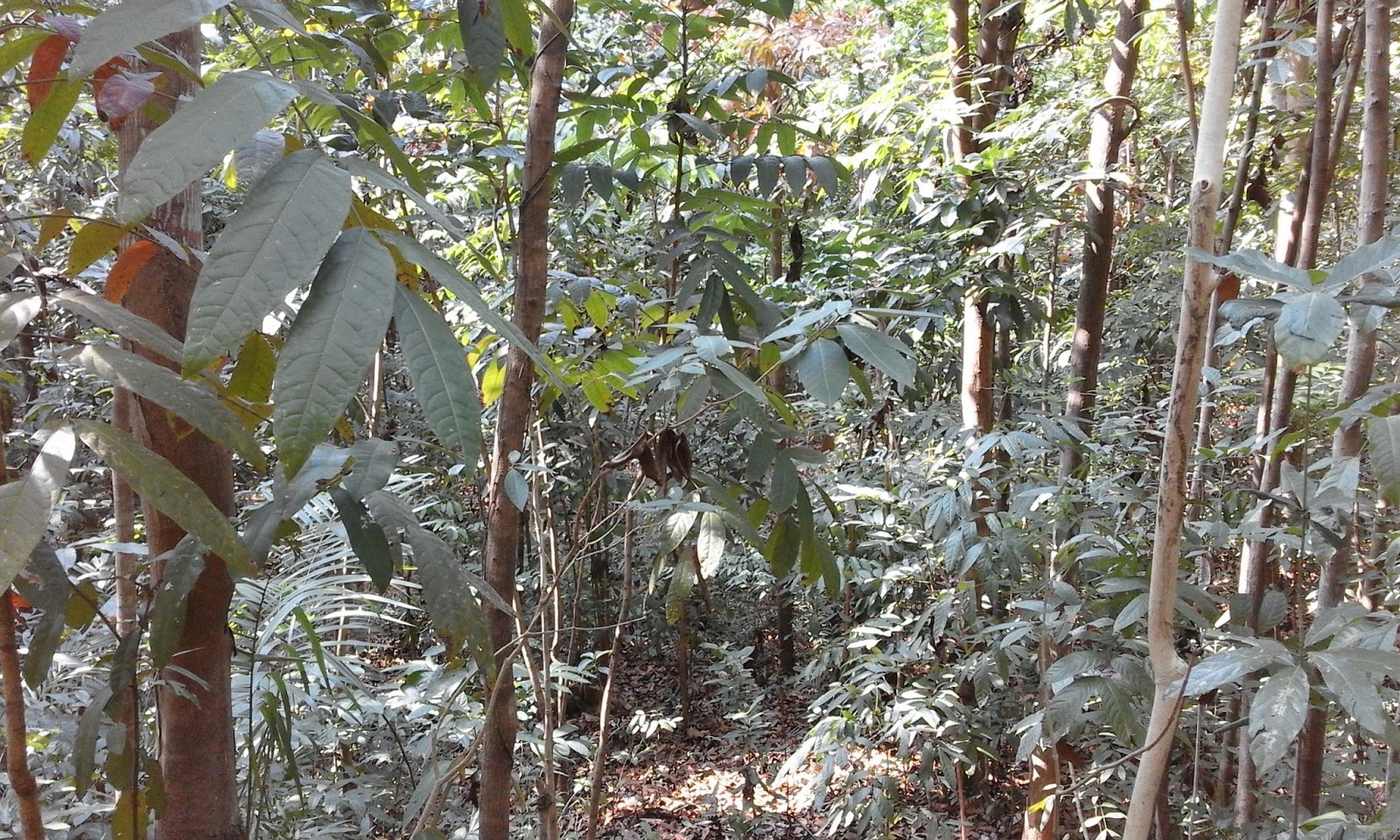
When trees of different ages grow, they look like this. This is between the well-spaced trees above, and the rice field near my treehouse.

Danny will be numbering the gmelina trees in the area that got burned two weeks ago. He will need an extra worker to assist him as Nong Endring is already old to walk and work long in far out areas of the farm,
--------------

See also:
Trees in the Farm, Part 3, February 11, 2013Trees in the farm, Part 4, June 23, 2015
Trees in the farm, Part 5, October 13, 2015

Sunday, March 06, 2016

Mini-dam terraces

* Note: The original title of this  post is "Terraces, Part 13". Four entries and sets of photos here.

(1) February 28, 2016

Last weekend I visited the farm. Little time as I have to go back to Makati same day, we only worked on this area. The 4th layer or row was repaired after the soil it was standing on has sunk.


How tall is this mini-dam, well compare its height with Danny, Nong Endring's son and helps his father in the farm, and Danny is about 5"10'.


(2) August 02, 2015

I visited the farm last Saturday. Previous weeks, we added the 4th layer as the stones continue to shrink, though at low rates now.


Side view, and left side of the structure, below.


And here is the adjusted structure, moving to 5 layers from the previous 2-3 layers. Nong Endring is standing at the top putting new grasses and leaves. See his height compared with the height of the structure. It's simply getting higher, sturdier.


The mini-pool at the back of the structure, the impounded water. Above photo,  taken 3 weeks earlier.

(3) July 14, 2015

The 3-layer terraces, March 2015 (top photo) and July 2015 (below). We started building the 4th layer last month.


(4) March 13, 2015.

Two weekends ago, I visited the farm. The big "wall" that we built several years ago, the stones are shrinking, as the soil below them becomes compacted. Time to adjust them. We removed one layer of stones each on the first and second rows, and put them on the third row.

Below, before we  worked on it. Notice the 3rd row, the sinking is visible...


After. The 3rd row became higher and more prominent.


Top view, before and after. Behind the big stones in each row are many smaller stones to stabilize them. Plus soil and organic matter as additional but weaker back up materials. Where did we get the soil and additional smaller stones...


From here. The trapped organic matter that has decomposed and became very soft soil. We removed about six inches deep on average here. This area becomes a temporary pool of trapped water and organic matter during heavy rains. Meaning, it can reduce a huge volume of water and hence, reduce flash flood, and reduce or prevent erosion of precious top soil in this part of the farm. 


--------------

See also:
Terraces, Part 9, July 07, 2014 
Terraces, Part 10, August 30, 2014
Terraces, Part 11, October 22, 2014
Terraces, Part 12, November 28, 2014

Monday, February 08, 2016

Creekside stone barriers

This area used to be the old road going up to other parts of the farm in Bugallon, Pangasinan. The series of huge flash floods, strong typhoons in recent years have altered the terrain of this road and the creek near it. Nong Endring hopes to convert this into an expanded rice field. All photos below taken last January 24, 2016.


We gathered dried leaves and branches and used them as filling materials. When the regular rice planting season starts this coming June, rice can be planted in this area.


A big and strong termite mound was demolished and flattened. The flattened soil can be used later as additional filling materials.


These are the stone barriers we erected. The creek on the left side, about 7-10 meters away, and the new or future rice field on the right. When flash floods come -- they occur several times a year -- the stones will help protect the new ricefield from strong current and deposits of different things.


Opposite view, creekside on the right, future ricefield on the left. This is not high or strong enough of course, this needs further reinforcement. Meaning more stones, but the initial barrier is already there.


The creek where we got the stones. There is also a need to deepen this by removing the bigger and medium size stones, so that water level will become lower during the rainy season.


When I go back there, we will add more stones to the barriers. Make them higher and stronger.

Sunday, February 07, 2016

My treehouse is 12 years old

My treehouse is now 12 years old. Time flies.
It was well-built, hugging a big and live mahogany tree, so it has survived some  of the strongest typhoons that passed by the area.

I took this photo last January 24, 2016.


Succeeding photos were taken last December 2015.
The 2nd floor. During the rainy season, this trunk of mahogany tree produces lots of new branches and leaves, yes, in the middle of the house.

No bed, yes. No one sleeps there, our caretaker goes home in the afternoon after feeding our dogs who watch the area 24/7. When I was still unmarried, I would go and sleep here every 2-3 weeks.


This part of the roof needs repair every year, or every 2 years at least. Why, because the trunk goes taller and bigger.

Part of the stair handle, gobbled by a branch.

 Opposite side, same spot.

A brace of the roof, the base has been swallowed by the trunk.

A pillar of the 2nd floor, photo taken from the 1st floor. This pillar is about 3 x 8 inches and it is slowly swallowed by the trunk.

Nong Endring sitting near the toilet.

Braces for the 1st floor, photo taken from the base. Their base also swallowed by the trunk.

Two more braces.

View from the 2nd floor.

Thank you treehouse, for the gift of shelter and shade. I still feel relaxed and rejuvenated whenever I visit you. And thank you, Mr. Mahogany, for hosting my treehouse all these years.
------------

See also:
My Treehouse, May 2012, July 17, 2012
My Treehouse, August 2013, August 21, 2013

Treehouse, Versions 2002 vs. 2014, April 23, 2014

My Treehouse is 11 Years Old, February 10, 2015

Sunday, January 31, 2016

Alexa ranking

I have eight blogs, four in blogger.com and another four in wordpress.com. Five of them have global ranks in alexa.com. There are perhaps hundreds of millions of blogs and websites worldwide, both in English and in other languages, many of these don't have any global rank.


(1) this blog is about agro-forest farming.
(2) http://funwithgovernment.blogspot.com/ is my main economics and political blog.
(3) https://seanet2.wordpress.com/ is about trade and investments in Asia, related topics.
(4) http://travelpinoy.blogspot.com/ is about travel and tourism plus my notes about my two girls.
(5) https://efnasia2.wordpress.com/ is about conferences of the Economic Freedom Network (EFN) Asia.

My three other blogs which have no global rank in alexa.com yet are the following:

(6) https://electricityasia.wordpress.com/, about energy and electricity issues in the Philippines and other Asian economies, plus some postings on energy policies in Europe and the US.
(7) https://ipinasia.wordpress.com/, about intellectual property (IP) issues in Asia, other countries outside the continent.
(8) http://rotarianpinoy.blogspot.com/, some rotary notes about our club and RI District 3830.

Thank you, readers.

Tuesday, January 26, 2016

Terraces at mahogany area, Part 2

These photos were taken last October 31, 2015. I only manage to upload and write about them today. This is the area between the mahogany trees and the rice field. Before the clearing...


And about 2 hours after. These 2 young boys helped us. They move and work fast. They are happy to work for about 4-5 hours with snacks and lunch, and a fee.


The uprooted and cut grasses, vines, leaves are deposited as filling materials at the back of the stone terraces.

Another round of clearing last December 19, 2015. The decomposed organic matter at the back of the stone terraces easily shrink in size.


Not far from this area is a stock of wood not good for lumber, to be used for charcoal making.


See also:
Terraces at Mahogany Area, March 10, 2015
Terraces, Part 11, October 22, 2014
Terraces Below the Treehouse, May 23, 2015
Mini-dam terraces, August 02, 2015

Creek and ricefield, Part 2

After typhoon Koppu (local name "Lando") fell down so many trees and caused heavy flash flooding in October 2015, the irrigation canal going to Nong Endring's rice field was covered by a thick layer of mud and sand. So Nong Endring painstakingly and patiently cleared all those things that blocked the canal.

These photos taken December 19, 2015.


It's back to irrigating the rice field. Nong Endring standing with our dog from Makati, Shiver. Shiver is now staying at Danny's house in the barrio near the farm.


An improvised water impounding system -- cogon, covered by sack with sand, covered by a layer of stones and sand.

The water enters here, with improvised barrier so that dried leaves from the creek won't enter the irrigation canal and contribute to silt and mud.


Many of these young trees beside the canal just grew on their own, never planted by us.

Nong Endring has expanded the rice field as more water can now enter the field.

Further down, a small natural pond, about 2 1/2 feet deepest part. This is where I submerge and relax my body for a few minutes before going back to Manila.

See also:
My swimming pool in the farm, 2005, June 10, 2011

Creek, canal and irrigation, September 05, 2011
Relaxing in the creek, January 05, 2013

The creek and the rice field, October 13, 2015