My article today in the online magazine, thelobbyist.biz.
WEDNESDAY, 04 JANUARY 2012 02:19
With the on-going global cooling – not warming, it’s a scam – we should prepare for more rain and more flood, not more drought; we should prepare for rising rivers and lakes, not rising ocean.
The bad news is that heavy typhoons like Ondoy, Pedring and Sendong are just “intro”. There will be more heavy rains and typhoons to come, not just for the next few years but for decades. I have discussed in various articles here in the past why global cooling will last for many years and decades. It’s the Sun and galactic cosmic rays that mainly determine climate cycles of warming-cooling-warming-cooling in our planet.
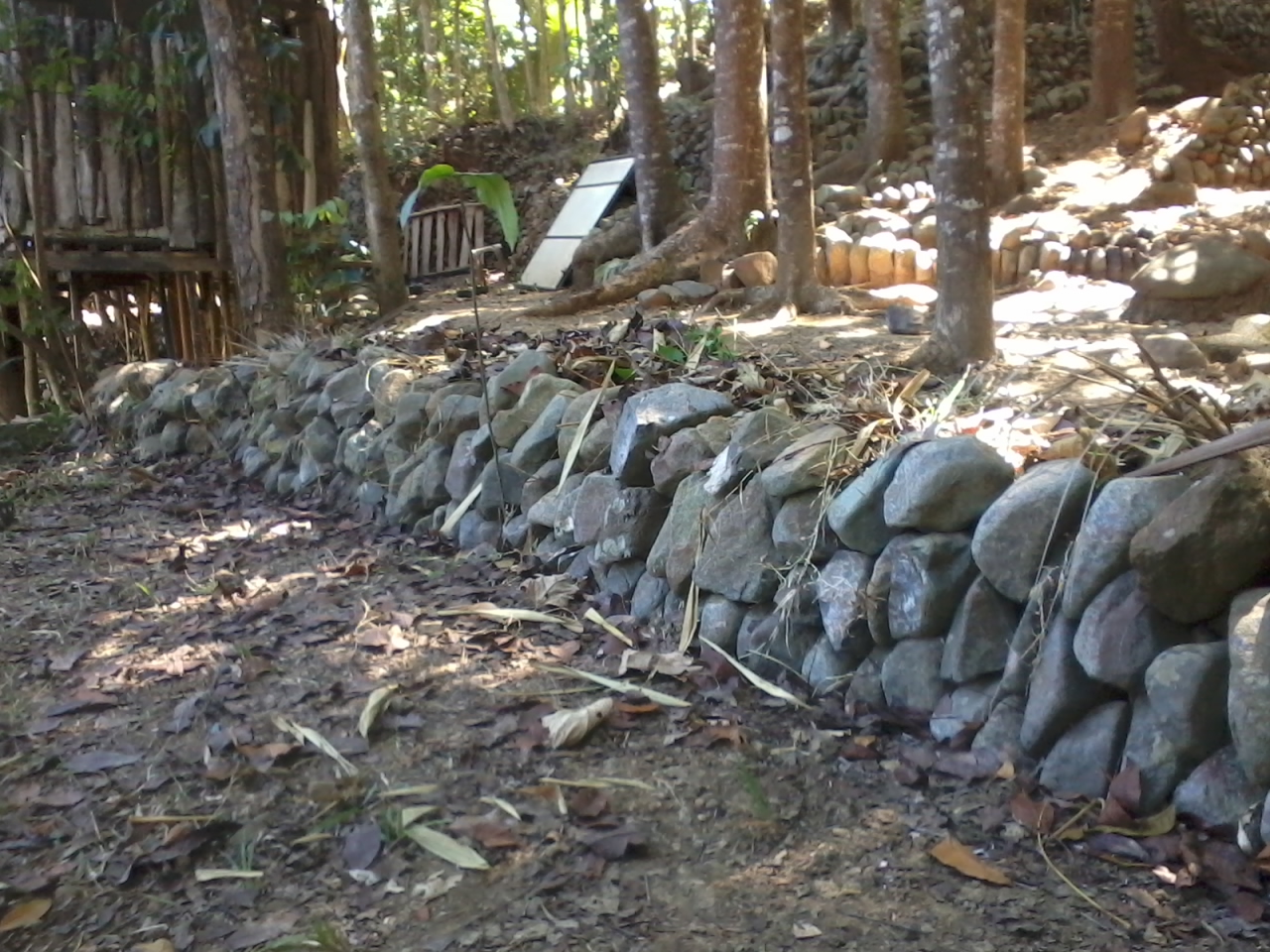
One way to reduce – but never stop or control – flash flood during heavy rains, is to trap and impound those rainwater along with eroded organic matter in small tributaries like small creeks and waterways. No need for government to do this, only some hard work, imagination and big number of stones nearby. Below is a mini-dam we constructed near my treehouse in a farm in Bugallon, Pangasinan.
Top photos, left and right as of July and December 2010, respectively. Lower photos as of December 2011. The man standing is our caretaker, Mang Endring. He is old now, so we get some younger guys to help us collect those big number of stones in a nearby creek. So far, this mini-dam, no cement or steel added, only stones and organic matter, has survived several strong typhoons with heavy flash flood in 2010 and 2011. Meaning our design of this stone terrace was good and stable.
Below are what’s at the back of this mini-dam and stone terrace. Top photos as of July 2010, lower photos as of December 2011. Note the big depression at the back, that’s the old waterway that is getting higher as the eroded topsoil and other organic matter from higher grounds are slowly trapped and impounded. This depression becomes a big pool during heavy rains, so you can imagine the big volume of rainwater that is prevented from contributing to flash flood in the nearby creek.
We started building that mini-dam around March 2010, but I forgot to take photos that time. It was just an experimental mini-dam which I thought would just be about two feet high. Now it’s about six feet high and it’s getting wider and taller.
We started building terraces near my treehouse in early 2004. Below, top photos as of 2004, and lower photos as of mid-2010. The mahogany trees are getting larger and taller. These structures have controlled soil erosion and strong water run off during heavy rains in this part of the farm.
We also built stone terraces in other parts of the farm, photos below. The principle is simple. Control or at least reduce soil erosion and flash flooding in sloping land by building stone terraces that will trap and impound temporarily strong water run off. The dried or new leaves and branches that are scattered are gathered and deposited at the back of those stone terraces. These organic matters later decompose and become rich and soft soil
The process should be endless as the trees change their leaves every year, so the organic matter deposit keeps rising each year. By extension, those terraces should be rising too – if we can keep up with the labor-intensive but rewarding activity.
For big waterways and creeks, it is impossible to build many dams, otherwise there will be more flooding of the lower plains. What is needed for those big rivers is continued dredging of the mouth of those rivers to make the river beds become deeper and hence, increasing their water holding capacity and prevent or reduce flooding of lower plains, especially river delta.
Government resources should better be used in such large-scale dredging of big rivers. Government should not waste our tax money conducting those useless climate meetings and climate bureaucracies that tell people to prepare for “more drought, more warming, rising ocean” as these things will not come. We should prepare for more rains, more flood, and rising rivers.